
Backrooms
Liminal Horror, The Labyrinth and Will Navidson

Like everyone at the moment, I went to see Kane Parson’s Backrooms film. I am, of course, contractually obliged to acknowledge how impressive a piece of work it is from a filmmaker so young, being that I don’t think he’s even legally allowed to drink in the US yet. For a debut, it’s really good. I’m not here in any way to try and undermine his work - and it’s really impressive that he’s managed to bring a level of thoughtfulness and skill to something which, as a result of making his name online, must have had an enormous pressure behind it. Backrooms is, after all, not Parsons’ ‘biological child’ - in that, he didn’t invent the concept of liminal horror. In fact, conceptually, the idea of a ‘Backrooms’ isn’t his to claim solely, either. It’s the product of Creepypasta online storytelling culture, derived from photographs which give off a certain energy - one of mundane discomfort, childhood mysticism and the very relatable anxiety of being lost in a supermarket - unable to find your parents.
When I first found out that a Backrooms film was in production, I couldn’t help but wonder what the potential legal ramifications were. After all, who really can lay claim to ownership over the aesthetic? The truth is, I don’t know. I’m sure A24 has people for that sort of thing, and I probably shouldn’t let it keep me up at night. I’ll concede that Parsons is the one responsible for fleshing out the concept most effectively, starting with his genuinely unsettling 3D rendered web-series by the same name. Using the free software Blender, he did a whole lot to manifest the core aesthetic - and as somebody who uses Blender myself - I feel I’m qualified to say that he’s really, really good at it. The combination of camera grain effects, realistic motion and brilliant design are really inspiring to somebody like me, who loves the idea that a rudimentary knowledge of a free animation software can lead to such creative fruits. Unfortunately for me, I’m not as good at Blender - plus my computer isn’t very powerful - so a lot of what I put out is closer to a bowling Strike! Cutscene. But you have to admire the potential of it all; starting from a free tutorial on how to model a 3D doughnut, and ending up building the entire set in real, physical space for the trendiest production house on the street, A24. The fact that we live in a time where this sort of independent expression is possible, at low cost, is encouraging.

Kane Parsons said that one of his primary influences for the series was the video game Portal - a game which I also happen to love - and you can definitely see its influence in the film. Portal came out a time when I was bored of video games, where if you’d have asked me, I would have told you that the last one I truly enjoyed was Mario 64. I felt like most games at the time were focusing on pushing graphical boundaries, but when it came to inventiveness in gameplay, most just settled on: You shoot man with gun and he dies. Big explosion. Portal’s gameplay, by comparison, was entirely focused on mystery. If you don’t know, in the game you play as a test subject - stuck in a labyrinth of corridors, rooms and puzzles - goaded on by a snarky, robotic voice through an intercom.
The central mechanic of the game is, you are given a ‘portal gun’ which opens up portals in the walls which you can travel through, and you have to figure out the best way to traverse the stage and complete the test. The robotic voice insults you and mocks your progress, until at one pivotal moment you appear to complete the ‘final’ test room. She informs you that your purpose has been fulfilled, and sets off a conveyer belt which carries you toward a burning furnace. This is the end of the game, you’re told. And it feels like it, because up until that point you’ve completed nearly 20 levels. It feels like it could be the end. Except, it isn’t. In fact, boldly, this is the point in which the true game begins. The point in which you have to use some ingenuity, and take full advantage of the skills you’ve accumulated up to that point. You notice a subtly placed area of wall, just outside of the test-zone, where your portal-gun can be used - and for the first time in the game up to now, you can not only defy the robotic voice, but you can ‘break the game’ and get into the space behind the test-zones. Of course, you’re not breaking anything. The game wants you to do this - it’s a simulation of disobedience. But, even so, it’s no less effective. Because the game has essentially tricked you into thinking it’s over, the moment is truly exciting, making you feel as though you’ve gotten one over on it. The technique it employs in holding off on the ‘true game’ for so long, means that when you do finally get to see behind the veil - to escape the ‘cave’, and see what’s making the ‘shadows on the wall’, you can’t help but wonder if there’s a larger message there. If this is something possible in your own life?
There is a YouTube channel that I like called BoundaryBreak. Essentially, what it is is, they look through the files of popular games, and roam the levels in ‘developer mode’ to see if there are any secrets hidden outside of the ‘boundaries’ of the stages. Apart from it being interesting to see how games are put together, it’s also fun to mentally extrapolate on how our own, physical world might similarly work. Simulation Theory is nothing new, but it’s certainly gained in popularity over the last decade or so, and I think this can only really be down to how commercially popular video games are. When you play a game, there are always limitations to what you can do. All games have an imposed ‘boundary’ - set by the developer - to keep you on track, so you can get through the experience in good time, and see through to the ‘end’ of the game. But video games aren’t always put together properly. Inevitably, things can go wrong, and regardless of the failsafes put in place to keep a player going in the ‘right’ direction, often glitches will manifest. You might get stuck in a wall, or ‘clip’ through the floor - and suddenly glimpse something you were never intended to see. Some unused asset, or room - liminal in its lack of proper design (being that it was never expected to be seen).
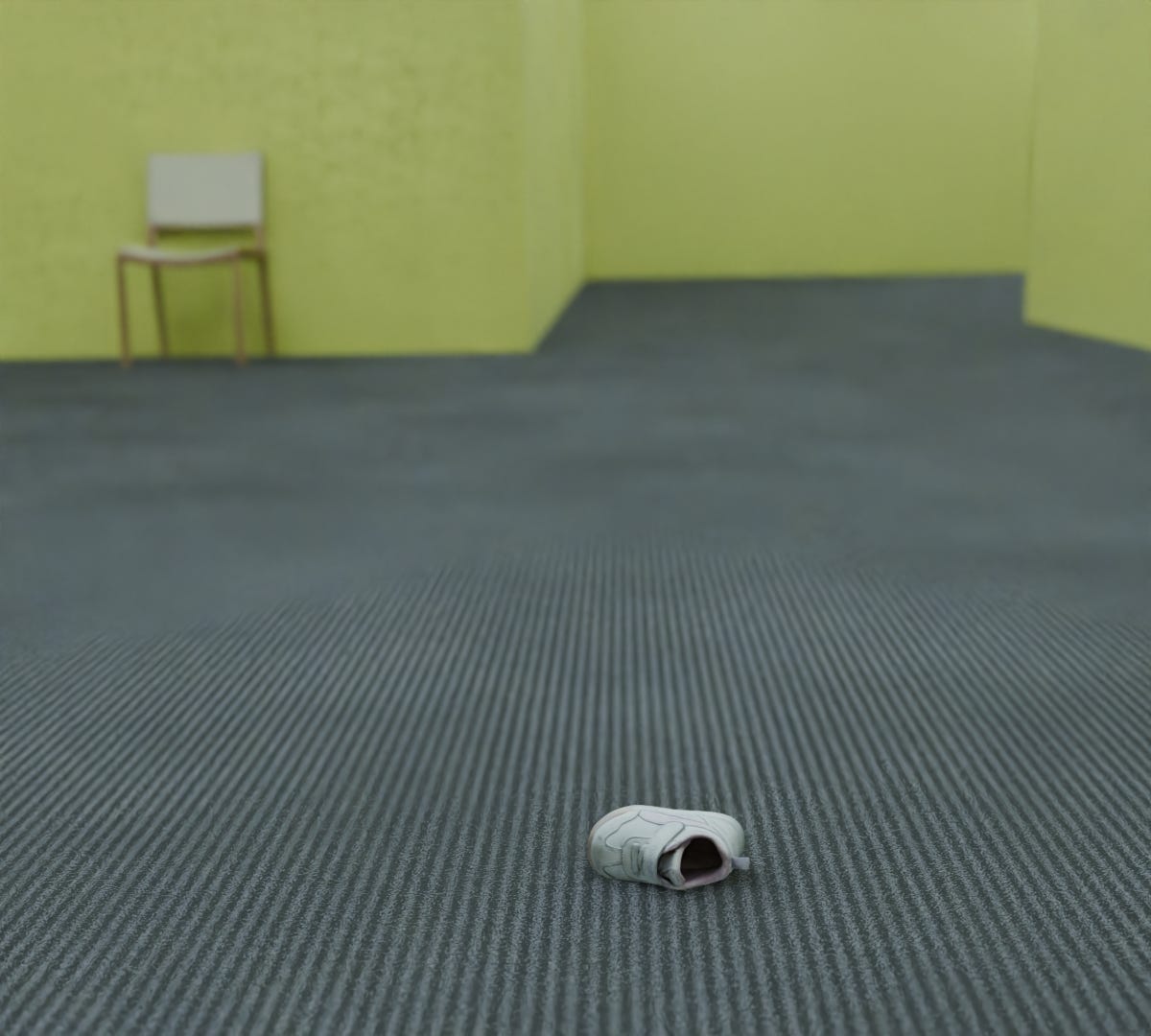
As graphics improve, and more and more focus is put on photorealism in games, it’s only natural that we will begin to project our own lives onto them more easily. To see our world reflected back, and wonder just how much in common the two worlds share. Of course, The Matrix has a lot to answer for in this regard, itself clearly influenced by the nature of digital programming and allegories of Plato’s Cave, but since it came out, people have only run with it. So much so that, some people view the strangers in their lives as ‘NPCs’ (non-playable characters) - the idea being that you are the ‘main character’ in life, and that all other people are merely programmed drones, perhaps on predetermined, set courses to push forward your story. Perhaps there is no ‘fully rendered’ world behind you? Perhaps only what’s in your direct eye-line is there, only being rendered in when needed to as to save processing power? Simulation Theory is fun to speculate on, up to a point, until it verges into dehumanisation. If we are all just in some game, then isn’t it our job to win it? I hope not.
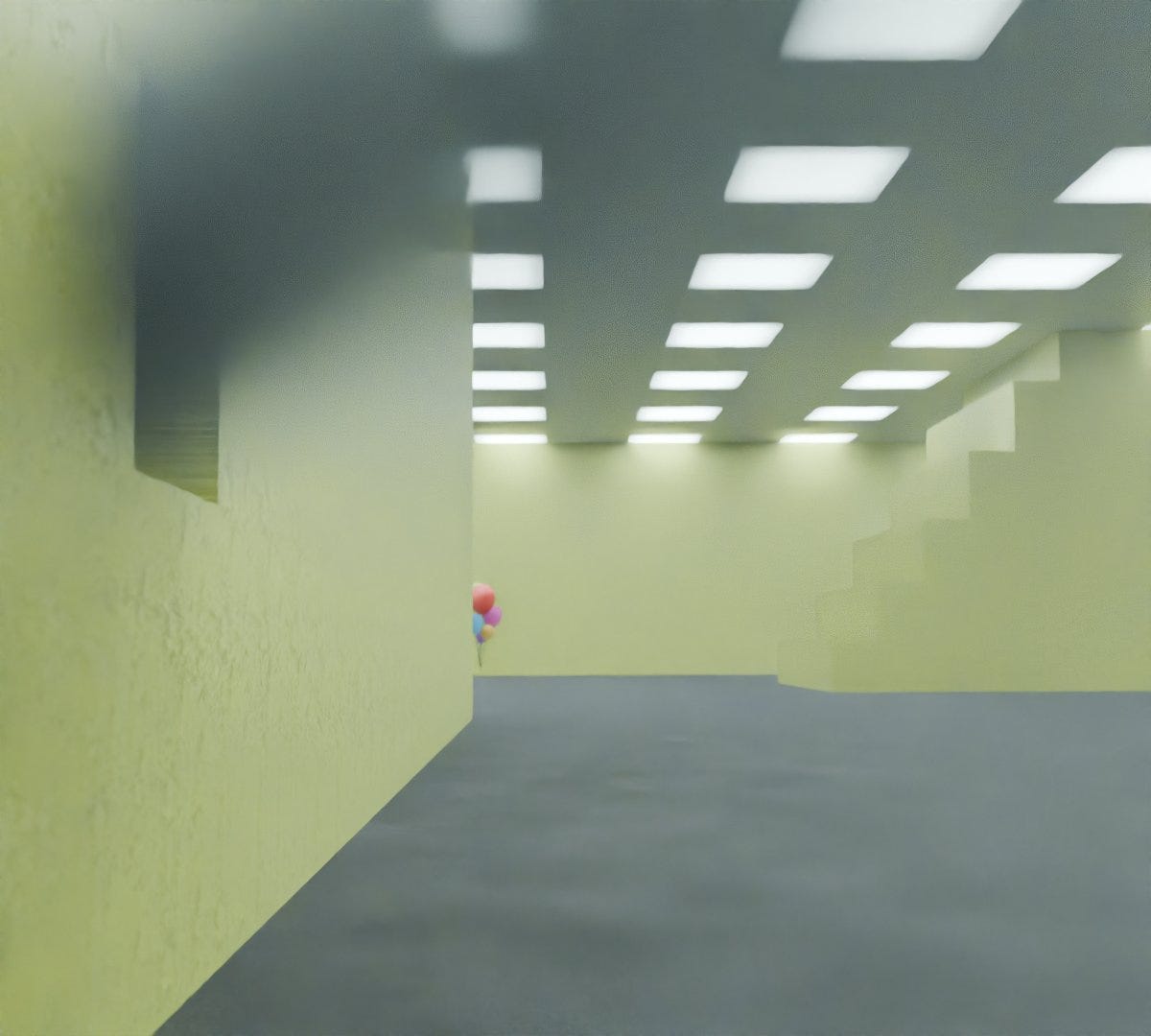
Backrooms, in its original form was an ‘ARG’ (augmented reality game), which isn’t a ‘game’ in the traditional sense. Instead, ARG’s are released sequentially, usually on YouTube, as micro-films. They are obtuse by nature, not conforming to the standard pace and story-telling structure of traditional, mainstream media. Instead, the ‘game’ in question is hyper-analysation. Viewers are encouraged to comb through every frame, and discuss the themes in forums - and even extrapolate on the story themselves, in their own versions - fully in spirit with the collectivist myth building that comes so easily to the internet. Backrooms was far from the first of its kind, but there’s no doubt that it captured the imagination of many. In fact, many are still rendering out their own versions of the world and uploading them online. New rooms, with new meanings - some doing away with the rancid yellow hallways and opting instead for unsettlingly beautiful aqua aesthetics, inspired by leisure centres or malls or McDonald’s kid’s party rooms. The whole endeavour is a group experiment in vibe building - an attempt to harness and communicate that uncannily eerie sensation of childhood anxiety, overwhelmed as we all were at one point with a world not designed for us. Everything too big, or just out of reach, or too small. These ARG’s are lore focused. They take advantage of the urge we have as interpreters, and tell us that everything is fair game for analysis. Good ARG’s don’t signpost their themes clearly, they allow for extrapolation. And they’re getting easier and easier to make. I even made my own ‘version’ on The Backrooms… (see below)
One film, itself previously an ARG, is Kyle Edward Ball’s unimaginably creepy Skinamarink from 2022. Skinamarink is probably the single most effective piece of work I’ve seen to capture that feeling of childhood anxiety. The film is slow moving - almost glacier-like in how it builds it’s world - opting less so for scrambling moments in labyrinthine corridors and, instead, on capturing the deep, horrible nausea of being too young to fully understand your own existence in physical space. Everything is shot low to the ground - sound is muffled - and light is dim. I’ll be honest with you, the first time I tried to watch Skinamarink I fell asleep, which isn’t to say the film is bad. If anything, I’d say it’s a masterclass in hypnosis. The world it builds is familiar in an almost long, lost way - giving you little glimpses of what it felt like, home alone, when your parents went out to a party and left you for a couple of hours. Skinamarink has cult status, but Kyle Edward Ball’s refusal to compromise his artistic goal of tone-setting over traditional story means that it never stood the chance of reaching the sort of commercial heights that Backrooms is currently enjoying.
Which, for me, is one disappointment I had with Backrooms. As impressive as it is, I don’t think Kane Parsons quite captures what it is that’s so compelling about his original web-series. Understandably, the film version is not just an extrapolation on the ARG. The producers know that this is a mainstream release, and they know that there is expectation there. It has defined characters, and psychological subtext. A screenplay, with a plot. A beginning, a middle, and an end. It has a lot of traditionally filmic scenes - people having conversations. Shot, reverse shot. Conflict and resolution. All things that feel, to me at least, at odds with the mission statement. There are moments which embrace the original form - those in which the VHS camcorder aesthetic is utilised, and the exploration of the Backrooms itself becomes the focus, and they’re thrilling. Unfortunately, they’re over too quickly - almost as if Parsons was worried that the admittedly impressive magnitude of the physical set would be undermined by not being shown off clearly enough. The thing is, the found-footage style is a strength, not a weakness. The janky nature of it is what most effectively communicates that feeling of being lost, and that, I think, is how we should feel in this context. It’s no fun to find your bearings. It’s no fun to see the monster clearly.
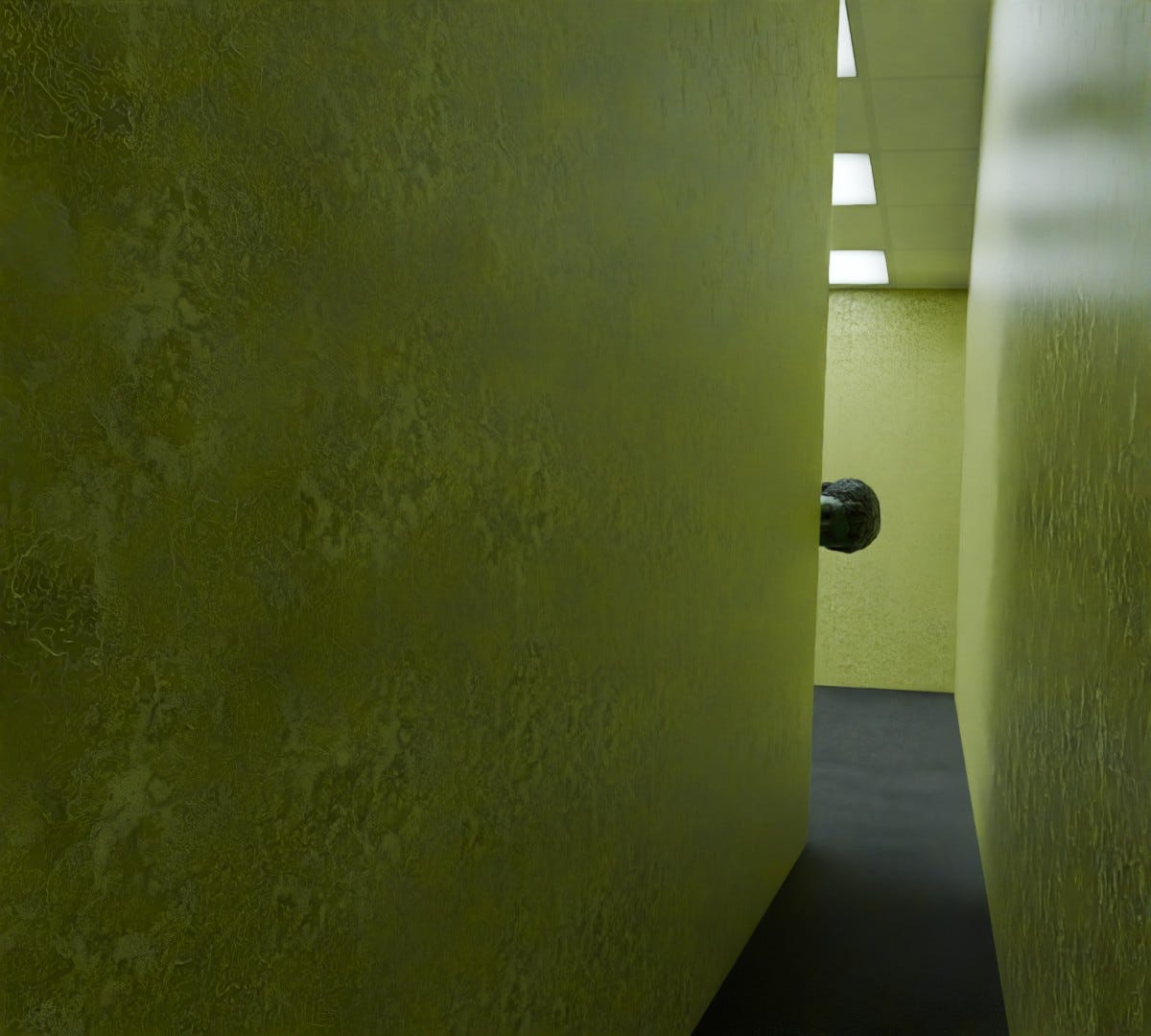
It’s difficult not to talk about The Blair Witch Project here - a film that, way back in 1999 captured this perfectly. Of course, Blair Witch had the benefit of a masterful marketing campaign, which took the rudimentary, cheap nature of the film itself, and framed it as a ‘true’ found footage experience. There were no endless hallways, or pirate-monsters - just woods, and snot, frantic shouting, and your imagination filling in the gaps. Arguably, there is no more ‘liminal’ a space than the woods. Every tree looks the same, and getting lost is an inevitability. It’s interesting because it’s very difficult to explain the impact The Blair Witch Project had at the time. The film’s success was, in some ways, a byproduct of the culture’s unfamiliarity with its form. Found footage as a genre wasn’t a short-hand as it is now, and many even wondered if you could call it a ‘film’. But Blair Witch worked - too well, maybe. It spawned an entire sub-genre, of wildly varying quality, which clogged up the horror domain for years afterwards. When Blair Witch got its inevitable sequel, it largely did away with all the found footage elements that made it so unique, instead opting to try and resemble something more traditionally filmic. And as such, people hated it. Backrooms did this right out of the gate - except, fortunately, people don’t hate it. Despite any personal disappointments I might have with it, it does work as a digestible ‘introduction’ to the concept of liminal horror.
For me though, the elephant in the room here is House of Leaves, a book by Mark Z. Danielewski.
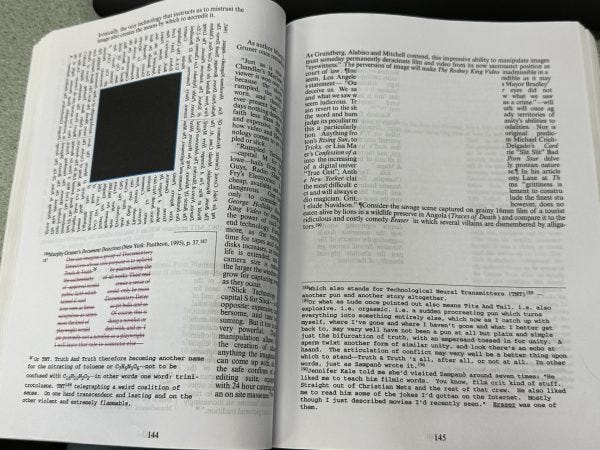
Released in the year 2000, House of Leaves follows the photojournalist Will Navidson, who - upon fixing up a new house - discovers that, inexplicably, the measurements of the dimensions inside it, are larger that the recorded measurements outside. This initial, subtle and creepy detail, sets off a series of consequences in which new hallways begin to manifest. New doors open up. And Navidson, pushed to obsession, takes it upon himself to explore these hallways - at the expense of his family. I’m only really scratching the surface here when describing what this book is about, however it’s a difficult book to summarise. The book itself is mysterious, and Danielewski formats it in confusing, experimental ways. Some sections need to be turned upside down, for example. Others require backtracking, or research on your own part. The book itself becomes a maze to get lost within, and by its ‘conclusion’ you’re left with the inescapable feeling that you might have missed something important. And you probably did. And so, it calls you back to it. Dares you to read it again, and see if you can better gleam something more. But you know, if you do choose to re-explore its labyrinth, you’ll feel stalked again. You won’t be alone. Its one of my favourite books of all time, and at points, strangely, feels like a ‘found footage novel’, if such a thing could even exist. And I’m not the only one to love it - there is a mammoth community of House of Leaves obsessives, drawn in by its dark, unsettling wonder. Many over the years have speculated what a film version of it might be like, and the consensus always seems to be this: impossible. If you read it, you’ll see why - what it has to offer can’t really be condensed into a tight 90 minutes.
But, as a result, creatives online have strived to try and visualise its upsetting aura. Kane Parsons, I think it’s fair to say, has gotten closest. The dingy, nonsensical geometry of his hallways have lots in common with House Of Leaves’ shifting house. Long stairways, leading infinitely downwards or, the sensation that you’re being watched by some minotaur-like entity, whose domain you’ve unwittingly trespassed in - this is really the essence of liminal horror, any revelations to be uncovered shrouded in dark corners. Backrooms though, while trying to forefront these themes, sort of loses something in translation.
That isn’t to say I didn’t have a good time with it. I did. It is, generally, nice to see something that at least strives for that atmosphere, and takes inspiration from so many of the things that I enjoy. Parsons has built his own lore, that I’m told holds secrets and easter eggs within it (if you know where to look for them). It has its own highly dedicated fanbase, who are already picking over ‘important details’ that you might or might not have missed upon first viewing. To me though, a lot of these feel a bit surface level, and a lot of the subtext about the characters and their psychology is spelt out. But there is still plenty there to look into, in much the same way The Shining has developed a proxy-industry of over-analysers, who imagine Kubrick’s every decision had some greater, profound meaning.
I can see why he’d want to prioritise showing off the details of the set design. It is incredible set design. The attention to detail in creating a physical replication of the backrooms is, in itself, a massive achievement, and I’m sure A24 will capitalise on it. I’m sure interactive horror-maze experiences are already being built in preparation for Halloween fright-night events. I imagine that Backrooms 2 is already in development - following some new character through the corporately dingy, sparse office spaces of a modern purgatory. And I wouldn’t hold it against them - liminal horror is an evergreen concept, in how nebulous it can be, and how primal a lot of its unsettling nature is.
But what is it about ‘liminal horror’ that’s so appealing to people today? What is the fascination with secret, underlying realities? Personally, I think it has something to do with a lot of us living on the intersection of large sea-changes. People my age (mid-30s) grew up at a time when, politically, things were a bit more hopeful. Not to say there weren’t bad things happening - 9/11, the Iraq War etc. but, in the years following, there was a sense that things were improving. That social progress was on the up-trajectory. That, if we only trusted in the linear passage of time, we’d get to where we were heading for. However, in recent years this feeling has dissipated. The world has never been more confusing. Things that at one time seemed unimaginable have come to fruition, and often it feels as though we’re heading backwards. If life is a maze, then we are definitely lost, deep within it. Maybe, in that way, the idea of a ‘backrooms’ is actually quietly optimistic. It suggests to us that that is where we currently are - and if only we can get our bearings well enough, we’ll be able to follow our breadcrumbs back out?
The idea that we are no longer in our once recognisable world is prevalent now. Many of us feel in a fugue-state - numb to the horrors we’re witnessing. The Mandela Effect, a phenomenon in which people believe the timeline of our reality has shifted in some subtle way, has come into prominence, inspired in part by scientific musings on the many worlds and string theories. We are hyper-aware of our insignificance - our own planet Earth playing the part of ‘the cave’. We know there are boundaries in which we simply do not have the technology to ever break - be it inwardly or, outwardly. There’s only so much we’ll ever know, and there’s only so much our brains are capable of understanding. Everything we perceive is only a relative projection, based on how our brains evolved. We’ll never truly get a glimpse into the world of forms, or see what the absolute, platonic ideal of a tree looks like. That is the true horror of our existence. We are stuck on a rock, surrounded by empty space, hoping that revelations, be they extra terrestrial or spiritual, will come to us.
The labyrinth, as a concept is so deeply engrained into our psyches. The Greek myth of Theseus and the Minotaur has been interpreted and recycled to death, and Backrooms is no exception to this tradition. The monster as allegory for the duality of self. The laying down of thread in order to, hopefully, find your way back through the maze. We are obsessed with mazes and labyrinths. It could be argued that their chaotic structure is our brain projecting out its own complexity through us, and daring us to go deeper. The architecture we create, and the sprawling road and street systems which make up the very zeitgeist of our lives - all of these things tell us something about what we are as a species. We create labyrinths every day, and challenge ourselves to get out of them - perhaps in an effort to steel ourselves for whatever reality comes next.
Steven L. Peck’s brilliant novella A Short Stay in Hell imagines a purgatorial vision of the afterlife. One in which your ‘punishment’ is decided, more or less, on a whim. The arbitrary nature of your turmoil is designed more as a means to kill time, and in the book - a recently deceased Mormon named Soren is tasked with traversing a ginormous, seemingly infinite library in search for a specific book - all about his life. Finding an incomplete version isn’t acceptable - even if it’s missing just a few letters. Only after locating the exact version will be granted passage out of ‘Hell’. Aside from the book being very funny, it is also mathematically overwhelming. It goes some way to capturing the innate horror of the human experience, and the potential afterlife.
When I first saw ‘liminal horror’ gaining popularity on the internet, I thought it was pretty funny. On the surface, it does at first seem absurd that somebody could derive ‘horror’ from a long hallway or a creepy wallpaper pattern. But that isn’t what it’s about, exactly. It’s about our primal fear of the uncanny - about feeling lost somehow in the familiar. Having some idea of what’s going on, but being unable to fully grasp what you need to in order to progress. Nausea and anxiety, not so much jump scares and guts.
Backrooms is a good film. But I’d be a little bit sad if it remained the best known example of the liminal genre. I feel like there is still so much more that can be done with it, conceptually. So I really hope we get more things like it. And, to be honest, I imagine we will - because our world sure as hell isn’t getting any easier to understand. The further down the corridor we get as a species, the darker it’s going to get - and the Minotaur is always going to be there, skulking alongside us.
We’ll just have to hope that the line of thread we laid down holds on to its form, and doesn’t also become frayed apart, beyond all recognition.
Thank you for reading this piece. Writing & animations by Jen Ives. There will be a new long form article, like this, every Sunday. If you enjoyed it, and would like to look into more of my writing/work, you can do so here: www.jenives.net - where there are links to everything. You can also email me at jeniveswriter@gmail.com if you fancy giving me some paid work or publishing my novel. No pressure, though.
Follow me on Instagram here
Below, is an exclusive article for paid Substack Members & Patreons. If you’d like to read it, please consider joining - as it really helps me to continue doing what I do.
Members Area
Tip Toe, Quitting my Job & guillotines.
Tip Toe
I’ve been watching (and working on a piece) about Tip Toe, the new Channel 4 series by Russell T. Davies, which is broadly about the state of queer rights in the UK. At the time of writing this, only 2 episodes have been released (the other 3 premiering tonight), and I have a lot of thoughts on it…
